How to Analyze Cinematography: A Practical Worksheet
To analyze cinematography, record what the camera shows, describe how it directs your attention, and test that interpretation against the scene. Keep visible evidence separate from guesses about equipment or the filmmaker's intention.
This worksheet works for a film-studies exercise, a director's reference session, or planning your own shoot. Use an individual still for composition, light, and color. Watch the sequence to discuss camera movement, duration, focus changes, and the relationship between shots.
Make three passes through a short scene
First: watch for the change
Watch without pausing. Note what changes between the beginning and end: who controls the conversation, what information becomes visible, or which space feels inviting or uncomfortable. Write this as a question rather than a conclusion. “Does the scene bring us closer to this character?” leaves room to inspect the evidence.
Second: log the shots
Choose a short, manageable passage and record each cut with its timestamp. Note shot size, camera angle, movement, and approximate duration. A camera move within a continuous shot is not automatically a new shot. Record sound and editing separately when they contribute to an effect you might otherwise attribute entirely to the camera.
The Film Education sequence-analysis glossary provides useful terms for framing, viewpoint, and editing. Use terminology to describe evidence, not as a substitute for explaining what changes on screen.
Third: pause on the frames that carry the change
Select the opening composition, an important turning point, and the closing composition. If the camera travels, include more than one frame from the same shot. Compare them before trying to name a lens or reconstruct the lighting rig.
A copyable cinematography-analysis worksheet
| Field | What to record |
|---|---|
| Reference | Title or source link, scene context, and timestamp |
| Framing | Shot size, camera height, angle, and what is excluded |
| Composition | First point of attention, subject placement, depth, and negative space |
| Camera over time | Static or moving; what is revealed, hidden, or kept in frame |
| Focus | Which plane is sharp and whether attention changes during the shot |
| Lighting | Visible bright regions, shadow edges, separation, and possible motivated sources |
| Color and tone | Dominant hues, warm/cool relationships, saturation, and tonal range |
| Interpretation | How these choices could affect the scene, supported by a specific observation |
| Uncertainty | What cannot be determined from the available frames |
| Recreation test | One variable to change in your own setup |
For a first attempt, write a sentence or two per field. Blank evidence is better than an invented camera specification. If you need vocabulary, keep the guides to shot sizes and composition techniques beside your notes.
Worked still: attention inside a bright room
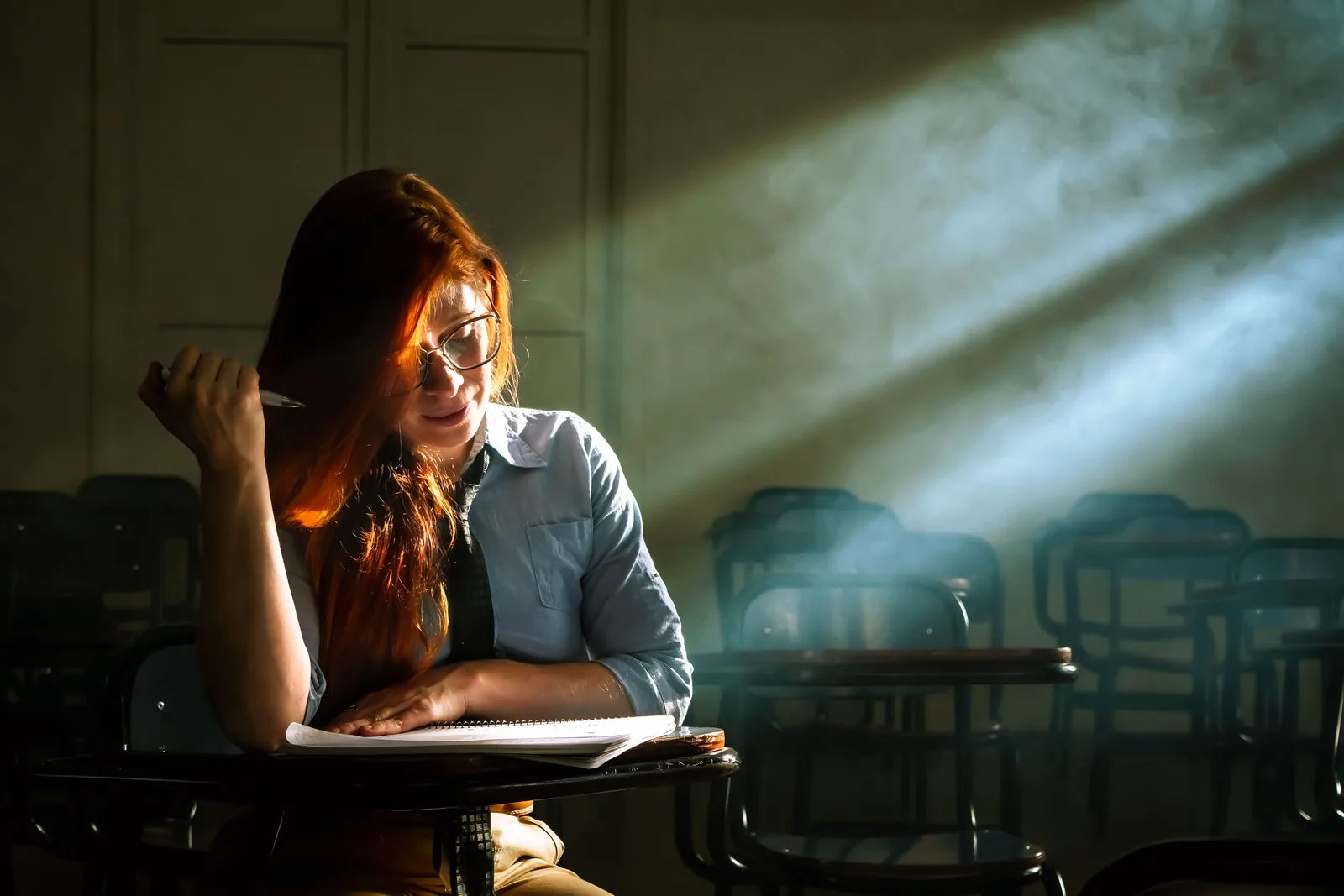
Observation: the seated person occupies the left part of the image; the face, shirt, and desk are bright against darker chairs. Diagonal bright areas cross the room. Interpretation: these brightness differences can guide attention toward the person while preserving a sense of the surrounding space.
Uncertainty: the frame alone does not establish whether the light is natural, supplemented, or created with fixtures. It also cannot tell us what the person has just heard or whether the camera is moving. Calling the scene “hopeful” or “threatening” would require narrative context.
Recreation test: place a subject beside a window and compare two camera positions that retain the darker background. Hold exposure steady while changing framing. Then assess whether the brighter face remains the first place your eye goes. This is a proposed exercise, not a reconstruction of the original shoot.
Turn notes into a supported paragraph
Use this structure: observation, effect, context, qualification. For example: “The subject sits off-center, with a bright face against darker seating. This separation draws attention to the person while leaving the room visible. In a scene about being watched, that open space could matter; without the surrounding sequence, the emotional meaning remains uncertain.”
Compare that with “The director uses a wide lens to make the character lonely.” The second sentence claims an exact mechanism and an intention without showing the evidence. A stronger analysis explains the visible relationship first and then tests its meaning against the scene.
Compare your read with a second interpretation
Ask another viewer what they noticed first, or compare your notes with a structured frame analysis. A disagreement is useful: perhaps you focused on color while they followed an eyeline. Return to the image and identify which observation supports each reading.
Ceeniq can help organize an individual image into camera, composition, lighting, color, and mood. It does not replace watching a scene or verify the original production setup. For the next practical step, use the guide to turning a frame breakdown into a recreation plan.
Compare your notes with a frame breakdown
Start with your own observations, then use Ceeniq to examine the same still and develop a setup to test.
Explore frame analysis